
Gum Grafting in Thornhill: Restore Your Gumline and Protect Your Teeth
Minimally invasive gum grafting — specialist care with no referral required.
Receding gums do more than affect the way your smile looks. When the gum tissue pulls away from a tooth, it exposes the root surface, leaving you with sensitivity, increased decay risk, and — left untreated — eventual tooth loss. If you have noticed your teeth looking longer, feel a sharp zing when you drink cold water, or a dentist has pointed out recession, gum grafting in Thornhill may be exactly what your mouth needs.
At MiNa Family Dentistry, located at 7191 Yonge St Unit 205 in Thornhill, Dr. Mehdi Adibrad — a dental surgeon with an MSc in periodontics and 10-plus peer-reviewed publications — performs gum grafting with a minimally invasive approach that restores both gum health and a natural-looking gumline. No referral is required.
What Is Gum Recession and Why Does It Happen?
Gum recession is the gradual or sometimes rapid apical migration of the gingival margin — meaning the edge of your gum tissue moves downward (on upper teeth) or upward (on lower teeth), exposing the root. It is one of the most common periodontal conditions, and it is not limited to patients with gum disease.
Understanding the cause is important because gum grafting addresses the existing recession, but it does not automatically prevent future recession if the underlying cause is not addressed. During your consultation at MiNa Family Dentistry, Dr. Adibrad reviews your brushing technique, periodontal history, anatomy, and bite to ensure the graft is set up for long-term success.
- Aggressive brushing — scrubbing with hard pressure or a hard-bristled toothbrush abrades gum tissue over time
- Periodontal (gum) disease — bacterial infection destroys the connective tissue and bone that hold gums in place
- Thin gum biotype — some people are born with thin, delicate gingival tissue that is more susceptible to recession
- Orthodontic treatment — moving teeth outside the natural bone envelope can thin or tear the overlying gum tissue
- Genetics — family history plays a role; if a parent experienced significant recession, their children face a higher likelihood
- Bruxism (grinding and clenching) — mechanical forces associated with bruxism can contribute to tissue breakdown
- Piercings and tobacco use — lip or tongue piercings and tobacco products can accelerate recession
What Happens If Gum Recession Is Left Untreated?
Recession is progressive in most cases. Without intervention, it tends to worsen — and the consequences compound. Sensitivity is often the first complaint patients mention. But root decay is the more serious risk, because a cavity on the root surface is harder to restore than one on the crown. Addressing recession early with gum grafting in Thornhill preserves both the tooth and its surrounding structure.
| Consequence | Why It Occurs |
|---|---|
| Root sensitivity | Exposed root cementum lacks enamel and reacts to temperature changes |
| Root surface decay | Cementum is softer than enamel and far more vulnerable to cavity-forming bacteria |
| Notching at the gumline | Abrasion and erosion wear away the softer root surface |
| Aesthetic concerns | Teeth appear elongated; gumline looks uneven |
| Tooth loss (severe cases) | Progressive bone and tissue loss can compromise the entire supporting structure |
What Is Gum Grafting?
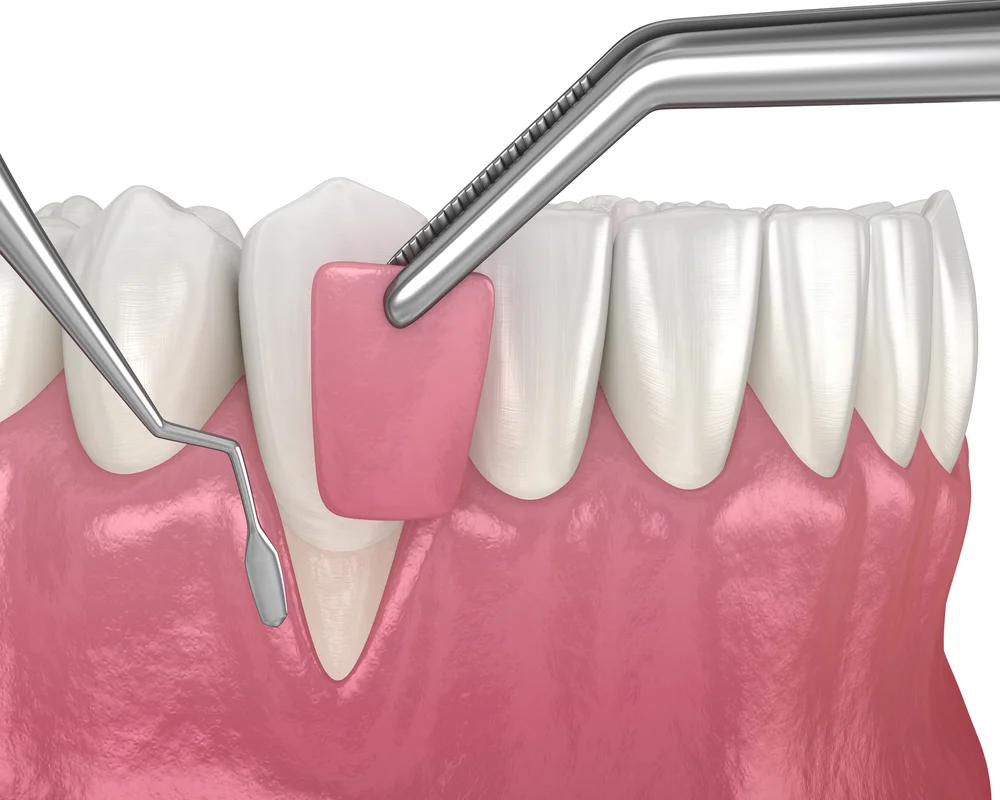
Gum grafting is a periodontal surgical procedure in which soft tissue is added to areas of recession to cover exposed root surfaces, increase the thickness of gum tissue, and re-establish a healthy, stable gumline. The graft material integrates with the existing gum tissue and, in most cases, forms a durable, long-lasting attachment.
Gum grafting achieves two goals simultaneously: health restoration (covering the exposed root protects against sensitivity, decay, and further tissue loss) and cosmetic restoration (a correctly positioned graft creates a more even, natural-looking gumline, often improving smile symmetry significantly).
Types of Gum Grafts
Several graft techniques exist, and the right choice depends on the extent of recession, the thickness of surrounding tissue, and the patient's anatomy and goals. During your consultation, Dr. Adibrad recommends the technique most appropriate for your specific anatomy and recession pattern.
Connective Tissue Graft (CTG) — Most Common
A small incision is made on the roof of the mouth (palate), and a thin layer of connective tissue is harvested from beneath the surface. The outer palatal tissue is sutured back, and the harvested connective tissue is tunnelled under the gum at the recipient site and secured. The CTG is widely considered the gold standard for root coverage because it produces predictable results and the palatal donor site heals well.
Free Gingival Graft (FGG)
A strip of tissue including the outer surface of the palate is removed and placed directly at the recipient site. This technique is typically used when the goal is to increase the width of attached gingiva (the firm gum tissue) rather than to cover roots, particularly in areas with very thin existing tissue.
Pedicle Graft (Lateral or Coronally Advanced)
Tissue adjacent to or above the area of recession is partially cut, rotated, or advanced to cover the exposed root. This technique avoids a palatal donor site altogether, but it requires sufficient donor tissue nearby and is not suitable for all recession patterns.
Alloderm (Acellular Dermal Matrix)
Alloderm is a donor tissue product derived from processed human skin. It is used as an alternative to palatal donor tissue when the patient prefers to avoid a second surgical site, or when the extent of grafting required exceeds what can comfortably be harvested from the palate. Results are comparable to CTG in many studies.
The Gum Grafting Procedure at MiNa Family Dentistry
Gum grafting is performed in-office at MiNa Family Dentistry in Thornhill. The process begins with a consultation and treatment planning appointment where Dr. Adibrad evaluates your periodontal health, measures recession depth and width, reviews X-rays, and discusses which graft technique is appropriate. A treatment plan and cost estimate are provided before anything is scheduled.
On the day of surgery, local anaesthetic is administered to ensure the procedure is comfortable. Most patients are surprised by how little they feel during the surgery itself. For connective tissue grafts, Dr. Adibrad uses a minimally invasive tunnelling technique to minimize trauma to the donor and recipient sites. Fine, dissolvable or removable sutures hold the graft in position. Most patients return to light activity the same day or the next day — swelling and mild soreness are typical for the first 2–3 days, and a soft food diet is recommended for 1–2 weeks. Full tissue integration and maturation occurs over several months, though the graft is stable well before that.
What Results Can You Expect?
For patients who undergo gum grafting in Thornhill with Dr. Adibrad, realistic expectations include significant root coverage (connective tissue grafts achieve complete or near-complete root coverage in the majority of cases), a meaningful reduction in root sensitivity within weeks as the graft covers and protects the root surface, restoration of a natural-looking gumline that is visually consistent with adjacent teeth, and stable, long-lasting results that depend on maintaining good oral hygiene and addressing any contributing causes.
Gum Grafting and Dental Implants
Healthy gum tissue volume is a prerequisite for successful dental implants. If you are planning an implant in an area with thin or deficient gum tissue, gum grafting may be recommended before or at the time of implant placement to ensure adequate soft tissue volume around the implant. Grafting after implant placement may also be needed if tissue recession develops around an existing implant.
Because MiNa Family Dentistry offers both dental implants and periodontal surgery under one roof, Dr. Adibrad and Dr. Kadivar coordinate these phases of treatment together, without requiring you to travel to a separate specialist's office.
Insurance Coverage and Cost in Ontario
In Ontario, gum grafting is generally classified as a periodontal surgical procedure. Many dental insurance plans provide partial coverage, particularly for grafts that are clinically necessary to prevent further recession, sensitivity, or tooth loss. Coverage depends on your specific plan, the number of teeth being treated, and whether you have met your annual maximum. Because gum grafting can also serve aesthetic purposes, insurers may require documentation of clinical necessity to approve coverage.
A typical gum graft in a private Ontario dental practice can range from approximately $800 to $2,000 or more per tooth depending on the technique, extent of recession, and number of sites treated. At MiNa Family Dentistry, the front desk team can provide a treatment estimate and a predetermination can be submitted to your insurer prior to booking surgery.
Watch & Learn
Further Reading
AAP: Surgical Periodontal ProceduresFrequently Asked Questions
Ready to get started?
MiNa Family Dentistry
7191 Yonge St Unit 205, Thornhill, ON L3T 0C4
(289) 597-7191
Mon–Thu 9:00 AM–6:00 PM | Fri 9:00 AM–3:00 PM